Where the new guidelines hit the mark, where they fall short, and the advice I give my patients about food.
by Caylin Cheney, Advanced Registered Nurse Practitioner
You might be surprised to discover that the US government has been offering recommendations for how we should eat since at least the late 1800s. Early on, the guidelines were mostly focused on food safety and teaching people about vitamins and minerals. It has evolved a great deal in the last 130 or so years, as you might expect!
The Department of Health and Human Services (HHS) recently came out with a new food pyramid (and associated guidelines) alongside the US Department of Agriculture (USDA) and it’s gotten a lot of attention. Contrary to what some headlines say, many of the guidelines are the same as ones released in 2020 – but with some big changes related to protein and dairy, as well as specific call outs to avoid what the agencies call “ultra-processed foods.”
As a provider, I want to give my perspective on the new food pyramid and the advice I give my patients about balance when it comes to food – especially right now, when there’s a lot of pressure to change how you eat or what your body looks like in the new year.
First: We should look at all guidelines with a critical eye and know their limitations
New guidelines come out all the time and it’s vital that individuals and providers alike scrutinize them with a critical eye. New guidelines around hypertension also just came out, for example, and while I’m generally excited about those, I still think there is room for criticism.
Guidelines around food are especially tricky because what you eat is influenced by where you live, your income, your cultural and religious background, the time you have in the day, and your relationship with food. You know yourself and your life best and it’s vital to review guidelines with a lens of, "Does this work for me and my situation?”
It’s also worth noting that all guidance has limitations. In fact, guidelines will often note those shortcomings! These new dietary guidelines, for instance, call for continued research to examine causal links between eating "natural" and positive health outcomes. One reason this is so difficult? There are no standardized definitions for what terms like "natural," "highly processed,” and "ultra processed" really mean.
And lastly, one of the greatest challenges to any guidelines published today is getting people to actually use scientific evidence in their daily lives. I wish we all spent more time on that side of the equation rather than just creating more recommendations.
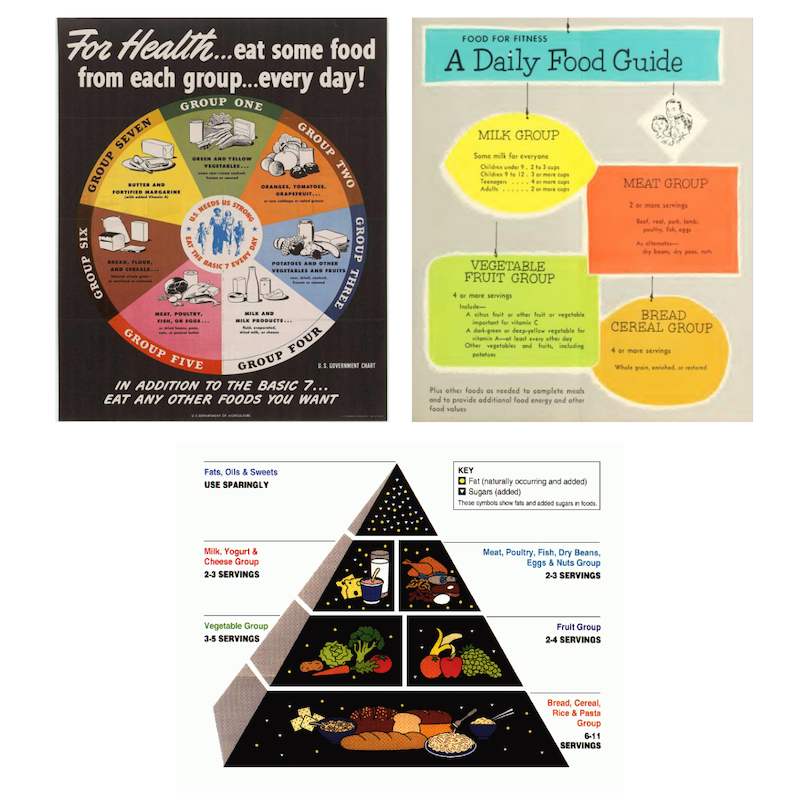
Food guidelines from the federal government, in one form or another, have been around for a long time.
My view on where the new guidelines hit the mark – and fall short
In many ways, the new food pyramid is not all that different from the previous 2020-2025 dietary guidelines and still generally mirrors a Mediterranean-style diet in its broad strokes. This type of diet remains the most researched and widely recommended type of eating style for heart health and preventing chronic disease. The new guidelines also reflect enduring guidance to limit processed foods and added sugars in our diets, which I also recommend to my patients. (In the absence of a standardized definition for “processed foods,” I encourage less food from packages and boxes!)
However, it’s important to recognize that the new food pyramid is internally inconsistent – that is to say, it contradicts itself – and that is concerning. We know that excess saturated fat is linked to heart disease and the new guidance retains advice to keep saturated fat intake to less than 10% of daily calories.
Yet, it also puts a great deal of emphasis on red meat, dairy, and animal proteins, all foods that are high in saturated fats. These foods are represented as large images at the top of the pyramid, giving the impression that you should be prioritizing and eating a lot of them. The website for the new pyramid and guidelines also declares that HHS and USDA are “ending the war on protein” which errs far more into ideology than evidence-backed recommendations in my opinion.
In response to the release of the new food pyramid, the American Heart Association (which is made up of thousands of scientists and medical experts) is urging “consumers to prioritize plant-based proteins, seafood and lean meats and to limit high-fat animal products including red meat, butter, lard and tallow, which are linked to increased cardiovascular risk.” This is in line with what I recommend to my patients, especially for those with high blood pressure or elevated cholesterol.
After examining the guidelines for my own personal health, I know I won’t be following the recommendation to eat full-fat dairy. It doesn't make my body feel good and doing so last year increased my cholesterol. This is what I mean when I say you should evaluate the guidelines for your own specific needs!
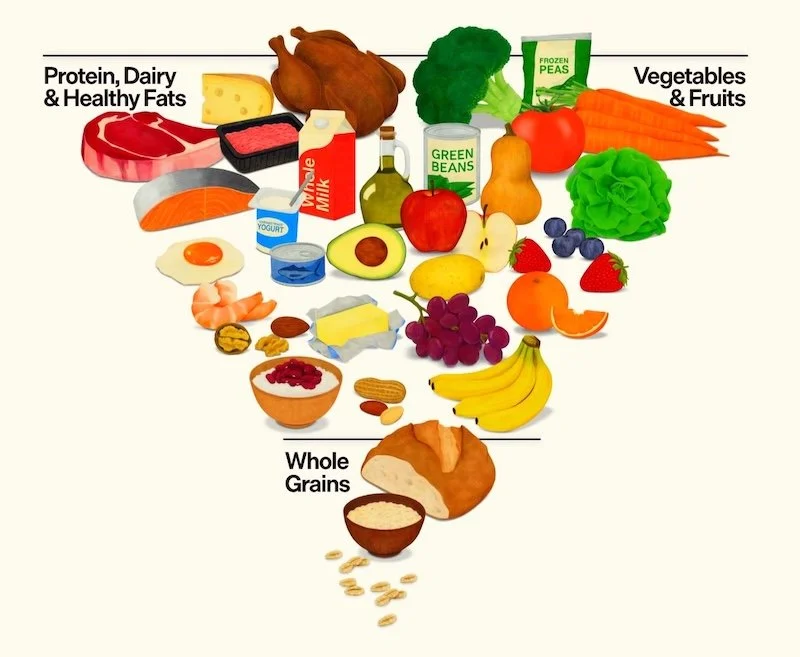
The new food pyramid released by HHS and USDA in January 2026.
Where else does the new pyramid fall short? A designer penned a great article on how confusing the new food pyramid is visually, noting that “good nutrition guidelines should reduce friction between knowledge and action. They should help people understand not just what to eat, but how to eat, clearly, intuitively, and in context. The new food pyramid does the opposite.” Another example of the disconnect between the pyramid graphic and the actual guidelines: On paper, the guidelines actually recommend 2-4 servings of whole grains each day. But the graphic includes almost no whole grains visually.
Additionally, I think the guidelines could be more clear about alcohol consumption. In general, evidence increasingly suggests that less alcohol is better and traditional recommendations of 2 drinks max per day for men and 1 max per day for women are likely too high. The new guidelines offer just "limiting" alcohol but don't give specific recommendations.

Related
Why the New Year Doesn’t Need to Mean a “New You”
What else I recommend as a provider
Let’s start with the basics: Fed is best! More often than not in my practice, I find that people just aren't eating enough. This is true for me as well. When I eat enough during the day and focus on foods that make me feel good, I have more energy, my day goes smoother, and my workouts feel so much better. I always laugh at myself in these moments because often the most obvious solutions (like eating enough food) can be the hardest to keep hold of! But eating consistently (and enough food to fuel your body) is absolutely vital for your physical, emotional, and mental health.
Additionally, I encourage my patients to take a holistic approach to their health. It’s not just about the foods you eat but also how your work, family life, mental health, physical health, and cultural background impact your relationship to food. Guidelines are just suggestions meant to make decisions easier. If you’re looking for straightforward suggestions on being healthier beyond just food, I put together a blog that lays out six basics I encourage my patients to focus on.
I wish that if we could just all eat the "right foods" that we would be healthy, happy, and secure. It's just more complicated than that! Don't use these guidelines (or any guidelines) to beat yourself up for not doing the "right" thing or still having health concerns despite following them.
Recent Blogs