Here are four reasons why the name change from PCOS to PMOS gives me real hope as a provider.

by Caylin Cheney, Advanced Registered Nurse Practitioner
The name of a condition holds immense power in medicine. It influences how providers treat, how insurance covers, and how patients feel. And thanks to an “unprecedented, rigorous, multistep” global effort that lasted 14 years, PCOS has a new name: polyendocrine metabolic ovarian syndrome (PMOS).
On the outside, it may just seem like one letter in an acronym, but this name change actually gives me a lot of hope, especially for the 1 in 8 people born female who have it. Here’s why.
1. The old name was misleading–especially the “cyst myth.” The new name paves the way for earlier, more accurate diagnoses
For decades, the PCOS name trapped a complex, whole-body condition inside a narrow, imprecise box. That box gave providers and patients alike tunnel vision about the condition: A lot of focus on so-called cysts and the reproductive system alone.
Dr. Melanie Cree was part of the renaming and noted that “confusion over the signs and symptoms of PMOS has contributed to not only delayed diagnosis and fragmented care but also stigma and anxiety about the condition and disengagement with care.”
As I wrote previously, you don’t actually need to have “cysts” on your ovaries to be diagnosed with PMOS. And if you do have these so-called "cysts" when you get an ultrasound, the reality is that they are actually immature follicles (small and pearl-like) that didn't develop into eggs.
By changing the name to polyendocrine metabolic ovarian syndrome, we’re no longer reducing this condition to one possible symptom. This is a chronic metabolic and hormonal syndrome that can affect your entire body and not just fertility or reproduction. As Elsa Cavazos (who has PMOS) said, “In its renaming, PMOS may no longer be treated monolithically.”
Bottom line: The old name was dismissive. This is a full-body condition and the new name reflects that lived experience. Hopefully, providers will no longer delay a diagnosis simply because an ultrasound comes back normal or because a patient isn't actively trying to conceive.
2. The new name could mean less stigma and confusion in patients and providers alike
Many of the visible symptoms of PMOS–like facial hair, hair loss, acne, and weight changes–carry a lot of stigma and can leave patients feeling ashamed. In fact, studies show people with PMOS are three to six times more likely to have an eating disorder and tend to have higher levels of anxiety and depression.
The old PCOS name also focused primarily on the reproductive aspects of the condition, which also could bring stigma or shame in contexts where fertility and childbearing is closely tied to a woman’s perceived value.
As Lorna Berry, a woman with PMOS who was part of the naming process said, “This is about accountability and progress. It is about my daughters, their daughters, and the countless women yet to be born. We deserve clarity, understanding, and equitable healthcare from the very beginning.”
Bottom line: The new name reframes the symptoms from a personal failing or a lack of willpower to a biological reality that should be treated accordingly.
3. Thanks to women speaking out for years, more people are paying attention to women’s health
In a fitting moment, it was a patient who first broke the news to me that PCOS had been renamed to PMOS. We were both excited–finally an update and a sign that the medical world is paying attention to women's health!
As Dr. Cree said, “patients with PMOS were the biggest drivers to change the name of the condition–their voices made it happen, and their continued advocacy will improve care.”
This is a heartening example of a change for women driven by women, with countless people coming together online and in real life, despite enormous hurdles, to make a big change on the global stage.
Bottom line? As one patient said, “Changing the name, for me, shows that they are starting to pay attention.”
4. The shift could drive more funding and better research
Conditions categorized strictly as women's health issues are vastly underfunded and underresearched. For example, “only 8.8% of the US National Institutes of Health's spending” was allocated to women’s health research between 2013 and 2023.
By officially embedding "polyendocrine" and "metabolic" into the name, hopefully researchers are no longer restricted to getting funding earmarked strictly for reproductive or women’s health, especially since we know that transmen can also suffer from PMOS.
And when a condition is labeled as an "ovary syndrome," cardiologists, mental health providers, and metabolic scientists may not consider it closely. But this new name invites a multi-disciplinary approach that could really accelerate understanding and treatment options for patients!
Bottom line? By changing the name to include "metabolic" and "polyendocrine," the condition breaks out of underfunded women's health silos and invites experts outside of endocrinology and gynecology to better understand PMOS and to find better treatments.
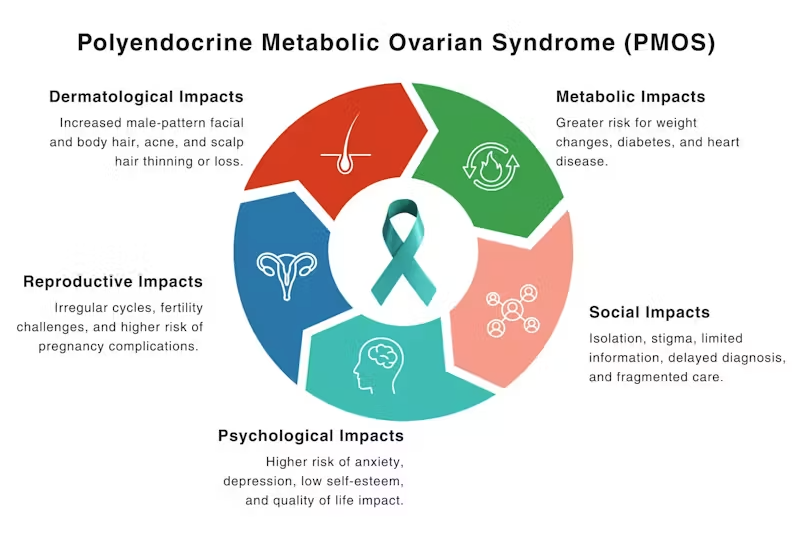
Diverse impacts of PMOS. (Image adapted by The Conversation from The Lancet), CC BY 4.0
Do you think you may have PMOS?
Many patients tell me they have tried to get a PMOS diagnosis in the past, but have felt dismissed by other providers. That doesn’t happen at my practice–you deserve to be seen, heard, and supported in your health journey.
At Whole Person Well Care, your dignity is not up for debate, and it certainly isn't tied to your fertility, your weight, or your hormones. If you do have PMOS (or any other condition), I am here to help you navigate the symptoms so you can feel comfortable and confident in your body. But you are already entirely worthy of kindness just as you are.
I provide health care for people in person in Seattle and Renton and virtually across Washington state. If you want someone to stand by you on your journey with PMOS or hormonal health, let’s get started—schedule your visit today.
Recent Blogs