
AI and Healthcare: A Provider's Honest Take
A nuanced look at what AI can and can't do for your health and wellness.

by Caylin Cheney, Advanced Registered Nurse Practitioner
You can’t log onto social media or turn on the television today without hearing about artificial intelligence. And because of that, I spend a lot of time thinking about AI and what it means for my patients and for healthcare broadly. Like most things in medicine, the reality is more nuanced than the headlines suggest.
So here's my honest take as a provider who cares deeply about access, equity, and your autonomy.
1. The access problem is real — and AI can help
Let's start with something I think about all the time: too many people simply can't get the care they need. Whether it's cost, where they live, insurance gaps, or a system that has historically failed marginalized communities, the barriers are real and they are significant.
AI has genuine potential to chip away at some of those barriers. It can help people find information, understand their symptoms, and show up to appointments more informed and more empowered.
But—and this is important—information is not the same as care. An AI tool can surface possibilities. It cannot examine you, sit with you, or hold the full context of your life and history the way a provider can. It doesn't know that your stress has been through the roof lately, or that you have a family history your charts don't capture, or that you've been dismissed by providers before and that shapes how you describe your symptoms.
So if you're using AI to help you make sense of your health, please do two things: check the sources carefully and keep your provider in the loop. Bring what you found into the conversation – because the right provider will know that's not a sign of distrust. For me, it's exactly the kind of engaged self-advocacy I love to see in my patients.
2. There’s no doubt: AI can be super helpful in certain applications
AI really does have remarkable capabilities in certain areas of medicine. Pattern recognition, in particular, is something AI does extraordinarily well. For instance, it can analyze vast amounts of medical data with a speed and accuracy that was previously impossible — like flagging irregularities in imaging and identifying trends across large sets of data. These are areas where AI has the potential to catch things human eyes might miss and to accelerate diagnosis in meaningful ways.
On an individual level, AI tools can also be great for tracking symptoms over time: noticing patterns in sleep, mood, pain, or other markers that might be hard to hold in your head across weeks or months. Like a smart watch or Oura ring, AI can provide the kind of longitudinal self-knowledge that is deeply valuable. I love when patients bring those insights into our visits.
3. A real concern: AI reflects humans, biases and all
AI systems learn from data — and that data was generated by humans, inside systems that have long excluded and harmed marginalized communities. Women have been dismissed. Black patients have been undertreated. LGBTQ+ folks have been pathologized. Trans people have been erased from datasets entirely.
If AI learns from that history, it risks further reinforcing those harmful biases. Presenting bias as objective truth can be more dangerous than explicit bias, because it's harder to see.
This matters enormously to me. I started this practice in part because I know what it feels like to be dismissed or questioned in a medical setting. I never want my patients to experience that — from me or from an algorithm. So when you're using AI health tools, be careful to examine for implicit or explicit bias.
You are the expert on your body and your lived experience. AI is not.
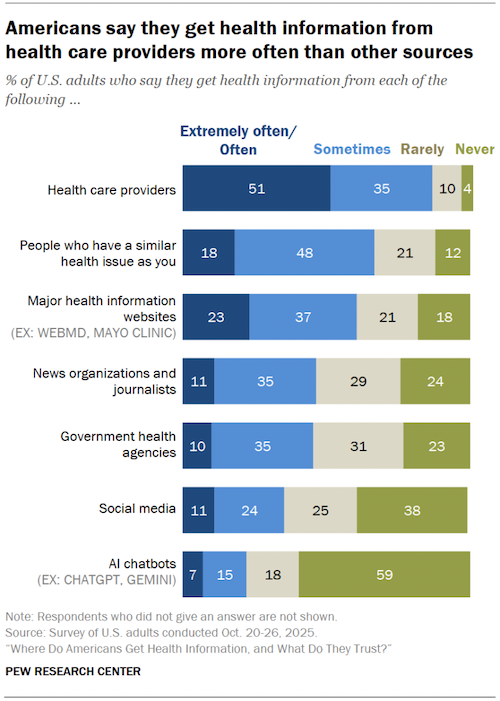
4. I’m glad to see that people still really trust providers over AI
I was relieved to read survey data from Pew Research that revealed Americans still strongly trust their providers when it comes to making decisions about their care even as they turn to AI for health information.
That reassures me not because I think providers are infallible (we're not), but because the relationship between a patient and a provider who genuinely sees them is something no algorithm can replicate.
I saw an ad recently for Amazon Health AI that essentially said you should turn to AI when you’re too embarrassed to talk to your provider about a condition like hemorrhoids or a weird rash. I want to be clear: No provider should ever make you feel embarrassed or uncomfortable talking about your symptoms. Please, genuinely, tell me about your hemorrhoids! I want to help and I’m not going to be judgmental or make you feel uncomfortable.
Bottom line? The goal of AI in medicine should be to support and extend access, not to replace the human connection that makes care actually work.
5. Your data matters — and it deserves protection
One more thing I want you to be aware of: when you use AI health tools, you are often sharing deeply personal information. Symptoms. Mental health details. Sexual health. Reproductive history. The kind of information that, in the wrong hands, can be misused and exploited.
Before you use any AI health tool, it's worth asking: Who has access to this data? How is it stored? Can it be sold or shared? These aren't paranoid questions, they're important ones. Your health information is yours, and you deserve to know how it's being used.
A few final thoughts
AI in healthcare is neither a miracle nor a catastrophe. Like most tools, what matters is how we use it, who benefits, and who gets left behind.
I'm hopeful about what AI could do to expand access and catch things earlier. I'm watchful about what it could do to deepen existing inequities. And I'm firm in my belief that no technology replaces a provider who actually knows you and your story.
If you ever want to talk through something you found online or from an AI tool, bring it to our visit. I’m all ears!
I built Whole Person Well Care to offer the kind of care most people wish they could find: Care that is thoughtful, holistic, and deeply personal.
Do you need extra support on your health journey? Make an appointment now.
Recent Blogs