PMDD affects up to 6% of people who menstruate, and social media videos point people to trendy treatments. They may work, but there are other, proven solutions you should try, too.
by Caylin Cheney, Advanced Registered Nurse Practitioner
If you're on the women’s health side of TikTok or Instagram, you've probably encountered videos where people swear that a daily Allegra or Zyrtec paired with Pepcid AC takes the edge off their premenstrual rage, anxiety, and despair. Some call it life-changing. Many people are desperate to try something when they’ve been left looking for answers with their symptoms dismissed.
As a nurse practitioner, I get why this trend is spreading. PMDD is exhausting, and many people spend years being told it's "just stress" or "just PMS" before anyone takes it seriously. So when a $15 drugstore combo promises relief, of course you want to try it.
Here's my honest take: the theory is interesting, the evidence isn't there yet, and if people are finding relief with this low-risk combination, that’s a good thing.
Let’s start here: What is PMDD?
Premenstrual dysphoric disorder (PMDD) is a cyclical mood disorder. It is a recognized diagnosis in the Diagnostic and Statistical Manual of Mental Disorders – it is not a personality flaw, a lack of coping skills, or "just bad PMS."
People with PMDD have severe emotional and physical symptoms in the luteal phase of the cycle, the week or two between ovulation and your period. Symptoms ease within a few days after bleeding starts and are minimal or absent the week after your period.
The prevailing theory is that PMDD isn't caused by abnormal hormone levels. Instead, the brains of people with PMDD appear to be unusually sensitive to the normal rise and fall of hormones like estrogen and progesterone (and to progesterone's metabolite, allopregnanolone, which acts on the brain's calming GABA system). Genetics likely play a role too.
Who does PMDD affect?
Research estimates that roughly 2 to 6 percent of people who menstruate meet full criteria for PMDD in a given year. That's millions of people. Many more have significant premenstrual symptoms that don't meet the full diagnosis but still absolutely disrupt their lives. People with a history of depression, anxiety, trauma, or a family history of mood disorders may be at higher risk for being diagnosed with PMDD.
Symptoms of PMDD
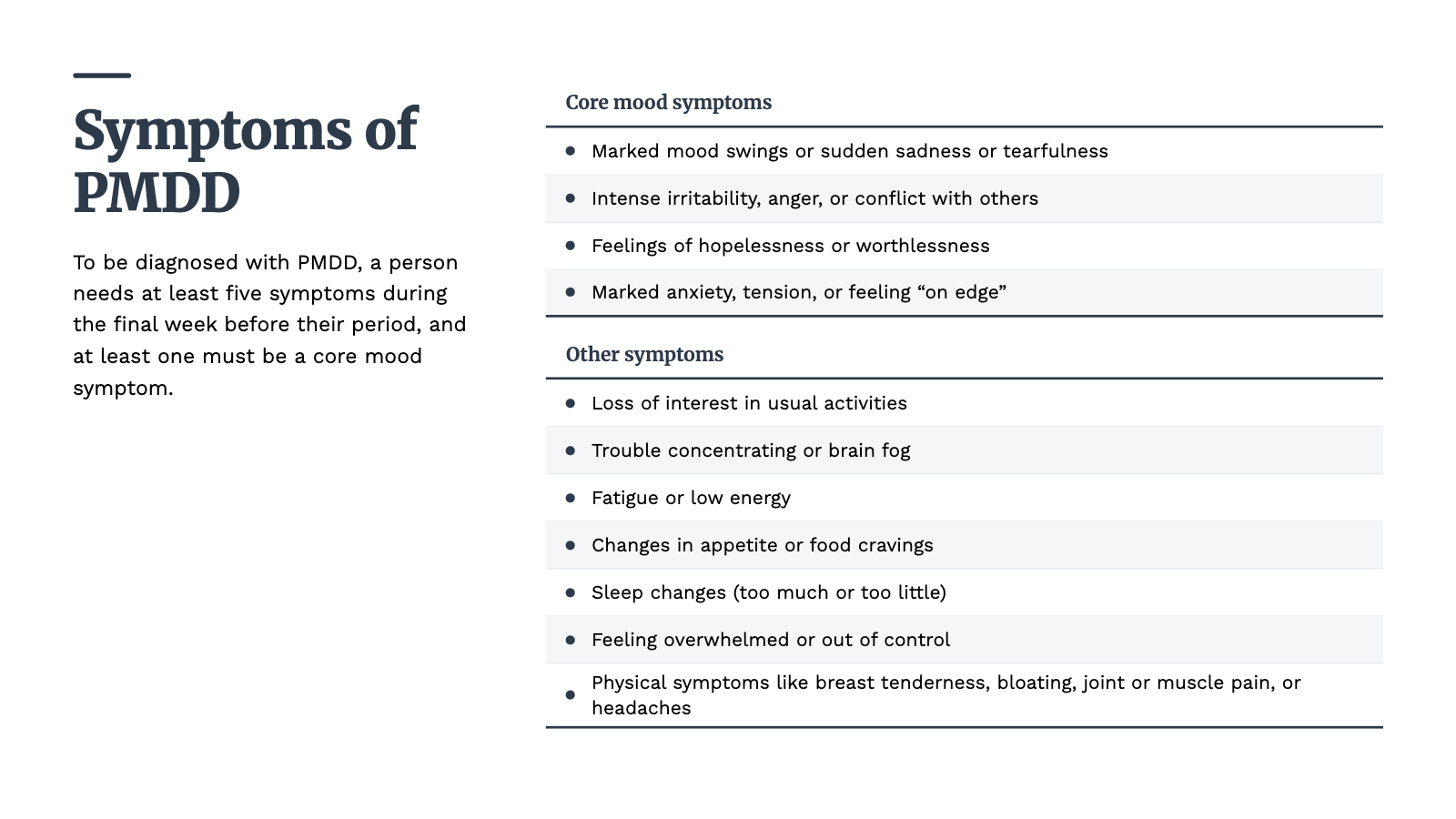
To be diagnosed with PMDD, a person needs at least five symptoms during the final week before their period, and at least one must be a core mood symptom.
Core mood symptoms:
Marked mood swings or sudden sadness or tearfulness
Intense irritability, anger, or conflict with others
Feelings of hopelessness or worthlessness
Marked anxiety, tension, or feeling "on edge"
Other symptoms:
Loss of interest in usual activities
Trouble concentrating or brain fog
Fatigue or low energy
Changes in appetite or food cravings
Sleep changes (too much or too little)
Feeling overwhelmed or out of control
Physical symptoms like breast tenderness, bloating, joint or muscle pain, or headaches
The cyclical pattern matters as much as the symptoms. If you feel like a different person for part of each month and then "come back" after your period, that's a hallmark of PMDD.
Tracking symptoms daily for at least two cycles is the best way to see the pattern, and it's how we confirm the diagnosis. Symptom tracking also helps separate PMDD from depression or anxiety that simply gets worse premenstrually.
And even if you don't meet all the diagnostic criteria, don't be discouraged! There are still things we can do to help relieve your very real symptoms.
Please read this part: PMDD can bring thoughts of suicide or self-harm. If you're having these thoughts, don't wait for your cycle to turn. Call or text 988 (the Suicide & Crisis Lifeline) or reach out to me or another care provider right away.
Trends in PMDD management: Do Allegra and Pepcid work?
The theory behind the trend
Here’s the idea: histamine, the chemical behind allergy symptoms like sneezing and itching, may also play a role in your menstrual cycle. Histamine levels seem to rise and fall over the course of the month.
Hormones may be part of the reason. Estrogen can signal certain immune cells, called mast cells, to release histamine. Histamine may then signal the body to make more estrogen. Each one could keep pushing the other up, like a loop. For some people, that loop might make mood swings, poor sleep, and pain worse. If so, blocking histamine could help calm things down.\
That’s where this medication combo comes in. Histamine acts on the body through two main types of “docking stations,” called H1 and H2 receptors. Allergy medicines like Allegra or Zyrtec block H1 so that histamine can’t dock. Pepcid AC (a heartburn medication) blocks H2. Taking both blocks histamine in two ways at once.
The idea isn’t as out there as it sounds. Allergists have used this same H1-plus-H2 combo for years to treat conditions like chronic hives. Using it for PMDD is new, though, and it hasn’t been studied much yet.
What the people trying it say
Tiktok videos have gone viral with people trying this combination and feeling less depressed, less irritable, and more energetic. One user on Reddit said:
“I take 20mg of famotidine (generic for [Pepcid]AC), when I start to get that ‘nails on the chalkboard’ feeling when PMDD first starts, and it helps within an HOUR.”
“Low dose famotidine has legitimately saved my life, my career, my relationships and mental health. I am completely normal during luteal as long as I stay on top of taking it (5mg every 6-8 hrs). Literally $5 for a bottle that lasts 3 months.”
On the other hand, some people don’t notice a difference. But either way, the buzz has been building online over this the last few years.
These experiences are real, and I don’t dismiss them. Many people describe real, noticeable relief from this combination. If that’s true for you, let’s talk about it! Keep me in the loop as your provider so I have the full picture when we’re working together on your health.
What the research actually shows
You know I will always be honest with you: there are no clinical trials testing Allegra, Zyrtec, or Pepcid, alone or together, for PMDD. Experts reviewing the trend have called it an "evidence-free zone," meaning we don't have proof it works, but we also don't have proof it doesn't.
A few important points:
"Biologically plausible" is not the same as "proven." The histamine-estrogen link is a real area of research, but most of the evidence is indirect. PMDD's emotional symptoms appear to be driven mostly by the brain's response to hormone shifts, especially through serotonin and GABA pathways, not primarily by histamine.
Newer antihistamines like Allegra mostly stay out of the brain. They're designed that way, so a direct effect on mood would be surprising. That doesn't mean something else isn't going on, but the mechanism isn't clear.
Some people may have a second, overlapping issue. If you also have seasonal allergies, histamine-related symptoms, or a mast cell condition, treating that could make you feel better overall, even if it isn't treating PMDD itself.
Placebo and expectation are powerful. Mood symptoms respond strongly to hope and to feeling like you're finally doing something. That doesn't mean the relief isn't real. It just means we can't tell what's causing it without trials.
Sedating antihistamines can mimic calm. Older ones like Benadryl can make you sleepy and foggy, which can feel like anxiety relief but isn't treating anything.
My honest take: low risk for what might be a high reward
If you're curious about the combo, or you've tried it and it helps, I'm not going to tell you that you're imagining it. Your experience of your own body is the most important thing, and for most healthy adults these are low-risk over-the-counter medications used at standard doses. If it helps you and you aren't experiencing negative side effects, there's generally no harm in continuing.
As I mentioned earlier, the one thing I'd ask is that you speak to your care team and pair these medications with treatments that have real evidence behind them.The biggest risk here isn't a side effect. It's the opportunity cost of spending months relying on a combination that hasn't been tested while a first-line treatment that works for most people goes untried.
A few practical notes if you decide to try it:
Talk with your provider first, especially if you're pregnant or breastfeeding, have kidney or liver problems, or take other medications. Antihistamines and famotidine can interact with other drugs and may need adjusting in some situations.
Possible side effects include drowsiness, fatigue, dry mouth, headache, and stomach upset.
Take an evidence-based approach! Track your symptoms with and without it so you can tell whether it's truly helping.
Don't stop or skip a prescribed medication, such as an SSRI or birth control, to try this instead.

Wide Awake at 3 AM? It Might Be Perimenopause
The links between perimenopause and insomnia, explained by a nurse practitioner. Read more →
Treatments that are proven to work
The good news is that PMDD is treatable, and we have solid evidence for several options. The right fit depends on your symptoms, your health history, and whether you want contraception.
SSRIs (first-line): Selective serotonin reuptake inhibitors like sertraline, fluoxetine, and paroxetine have the strongest evidence for PMDD, and roughly 60 percent of people benefit. PMDD is unusual because SSRIs often work within days instead of weeks, so you can take them every day or only during the luteal phase (the two weeks before your period), whichever works better for you. Starting an SSRI for PMDD does not mean you're "depressed" or that you'll be on it forever.
Certain birth control pills: A pill containing drospirenone and ethinyl estradiol, taken on a 24/4 schedule, is FDA-approved for PMDD. It works by suppressing ovulation and smoothing out hormone swings. The benefit is generally more modest than with SSRIs, and some people notice a worse mood on hormonal birth control, so it's worth having a provider monitor how you feel.
Cognitive behavioral therapy (CBT): CBT can help as a standalone treatment or alongside medication. It builds skills for managing the intense emotions, thought spirals, and relationship strain that can come with PMDD.
Lifestyle basics: Regular exercise, consistent sleep, limiting alcohol and caffeine in the luteal phase, and eating regularly can take the edge off. They help, but they usually aren't enough on their own for moderate to severe PMDD, and it's not your fault if they don't fix it.
For severe or treatment resistant PMDD, we may need to explore other options together. You deserve care that feels safe, thoughtful, and truly centered on you and I'll make sure that’s what you find in my care.
When to talk to a provider
Consider making an appointment if:
Your mood or physical symptoms follow a monthly pattern and disrupt work, relationships, or daily life
You've been told it's "just PMS" but it doesn't feel that way
You're having thoughts of self-harm or suicide (seek help right away: call or text 988)
You've been relying on over-the-counter fixes and still aren't feeling like yourself
At Whole Person Well Care, I take a whole-person approach to your health, including with PMDD. I am committed to doing whatever we can to relieve your symptoms and build a plan that fits your body and your life, whether that includes medication, therapy, lifestyle changes, or a combination (a combination is usually what it takes!).
If you’re experiencing symptoms of PMDD, schedule an appointment today. I’m ready to help.