
Beyond the Gym: Everything You Need to Know about Creatine
For decades, creatine has been popular in the gym. Now it’s going mainstream – and for good reason. The first in my new Supplements, Simplified series.

This post kicks off a new series here on the blog where I'll be walking through individual supplements — what they are, what the evidence actually shows, and whether I think they're worth your time and money. I’m calling it “Supplements, Simplified.” First up: creatine.
by Caylin Cheney, Advanced Registered Nurse Practitioner
Key Takeaways
Creatine is a compound your body naturally makes and stores mostly in your muscles. It also occurs naturally in meat and seafood and can be taken as a supplement in powder, pill, or gummy form.
Creatine monohydrate is one of the most well-researched supplements out there, and the evidence for muscle support is strong.
It's not just a "gym bro" supplement anymore. More women, especially those in perimenopause and menopause, are taking it, and early research suggests it may support brain health, too.
Side effects are generally mild and temporary, including occasional stomach upset, some initial water weight.
Supplementing with creatine isn’t right for everyone, especially folks with kidney conditions.
I get a lot of questions about supplements in my practice, and most of the time my answer is some version of "the evidence is mixed" or "let's talk about whether you actually need this" or even “don’t waste your money.” Creatine is different. It's a supplement I recommend often and with real confidence, and it’s one I’m being asked about more and more. So let’s dive in!
What is creatine? What does creatine do?
Creatine is a naturally occurring compound made from amino acids. Your body produces some on its own, and it's stored mostly in your muscles. Creatine isn’t protein – it’s a small molecule that helps regenerate the energy your cells use during short bursts of effort like lifting something heavy or sprinting to catch a bus.
If you’re not a vegetarian, you can also get some creatine through your diet because it occurs naturally in meat and seafood, particularly red meat and fish. The catch is that it's genuinely hard to get a therapeutic amount through diet alone – meat eaters generally get about a gram per day from food and vegetarians get virtually none. You'd need to eat several pounds of steak or salmon a day to approach the doses used in research, and your digestive system (and your heart) wouldn’t thank you for that. That's part of why creatine supplements are becoming so popular, even among people who eat plenty of animal protein.
What are the benefits of taking a creatine supplement? Why are more and more people — especially women — starting to take creatine supplements?
When people talk about creatine supplements, they're almost always talking about creatine monohydrate. It's the form that's been studied the most extensively, and it's what I recommend to my patients trying creatine.
The best-established benefit is support for muscle strength, power, and lean mass, especially when paired with resistance training. That’s one of the reasons you’ve heard your friendly neighborhood bodybuilder talking about it for decades. But the research on creatine has expanded beyond athletic performance in recent years, which is part of why I've started recommending it more broadly in my practice.
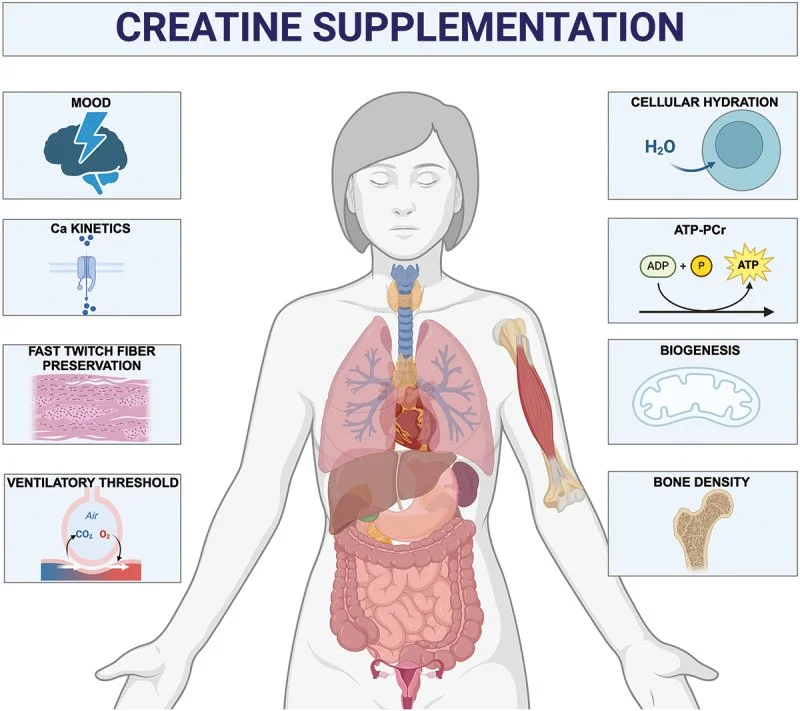
“Theoretical model for the implications for creatine supplementation in females specifically.” (National Library of Medicine, 2025)
We now have a growing body of evidence that creatine may be particularly valuable for women and people born female, especially around perimenopause and menopause. As estrogen declines during this transition, women naturally lose muscle mass and bone density more quickly. Creatine, especially combined with strength training, may help counter some of that loss and support healthy aging.
There's also emerging research into creatine's role in brain health. Early studies suggest it may be neuroprotective and could play a role in supporting cognitive function as we age, including some interest in whether it might help protect against dementia down the line. It's also gotten attention for supporting people dealing with brain fog. This research is still early compared to the muscle data, but it's promising enough that I keep an eye on it.
What are potential side effects of taking a creatine supplement?
Creatine is generally very well tolerated with few people experiencing mild side effects. The most common complaint I hear is mild stomach discomfort, particularly if someone starts with a high dose right away. Starting lower and working up, and taking it with food, usually takes care of that.
Some people also notice a bit of early weight gain. This is almost always water retention as your muscles pull in more fluid, not fat gain, and it tends to level off over time.
Do I need to do a "loading phase"?
You may have seen recommendations to start creatine with a "loading phase" — typically around 20 grams a day, split into several doses, for five to seven days, before dropping down to a regular maintenance dose of 3–5 grams a day. The idea is to saturate your muscle stores faster.
Here's my take (and one that studies are increasingly backing up): a loading phase isn't necessary. It just gets you to the same saturation point sooner and with the higher potential for gastrointestinal side effects. If you're patient, taking a steady 3–5 grams a day will get you to the same place.
Why I recommend creatine for some patients
In the world of supplements, it’s not uncommon for me to tell patients to save their money. But creatine is one I genuinely recommend due to the extensive research behind it and low incidence of side effects.
A few practical notes if you're considering it:
You don't need to spend a lot of money. Creatine monohydrate is creatine monohydrate, and expensive branding doesn't necessarily mean a better product. Supplements aren't regulated by the FDA the way medications are, so I recommend looking for products that are third-party verified by an independent organization that isn't profiting off the sale of the product itself. Nature Made is a brand I point patients toward — it's third-party verified, widely available online and in stores, and reasonably priced.
As I mentioned, some people notice early water weight gain. It's not fat, and it typically resolves on its own within a few weeks.
And finally, creatine isn't the right choice for everyone. For example, If you have kidney disease or another condition affecting kidney function, I'd want to talk with you directly before you start, since creatine is processed by the kidneys. If you have bipolar disorder, it’s also worth a discussion before starting creatine. These are good examples of why it's worth bringing supplement questions to your provider rather than figuring it out on your own.
My bottom line
Creatine monohydrate is one of the most researched, most affordable, and most broadly beneficial supplements available, and I think it's worth a conversation for a lot of my patients–particularly women navigating perimenopause and menopause. As always, I'd rather talk it through with you directly so we can figure out if it makes sense for your body and your goals.
If you have questions about creatine or supplements in general, bring them to your visit. There are no wrong questions and the conversation is always worth having.
Recent Blogs